The Problem
The Shortfalls
A model built for another century. The problems it still creates.
For more than a hundred years, oil and gas have been produced in much the same way. The model built the modern energy supply. Today its limits set the industry's cost, schedule, safety and environmental record.
A model that did its job
The conventional model was designed in the early twentieth century to develop the world's super-giant fields, and it did that work. Its logic is centralisation and scale.
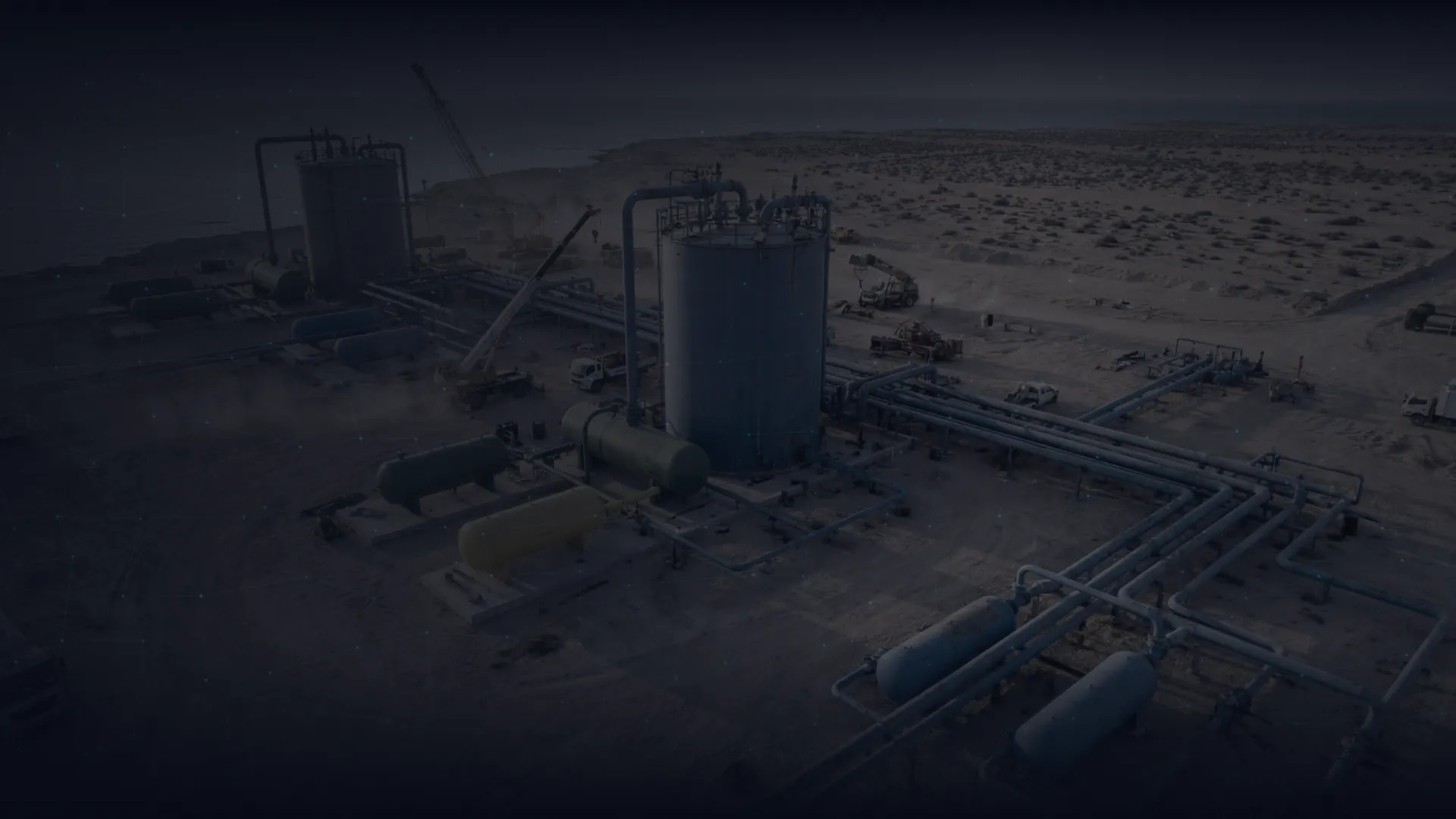
Picture a conventional field. Raw, unstable fluid leaves every well and travels, often a long way, to one central gathering centre. There it is separated and treated in a single plant, held in a tank farm and sent on. A dedicated power plant or substation keeps everything running, and a flare burns the gas that cannot be used. Every barrel passes through one place.
The limits described on this page come from the shape of the model itself, not from the people who build and run its plants. Not every field has every feature described here, and the size of each problem differs from field to field. What follows is the pattern, in the order the problems arise: from the decision to build, through the journey of the fluid and the life of the plant, to the day production ends.
Before the first barrel: capital and time
A new large development needs very large capital before the first barrel moves, and budgets routinely overrun. In a review of 365 oil and gas megaprojects, 64 per cent ran over budget and 73 per cent missed their schedule. Final costs averaged 59 per cent above the first estimate, and even after the final investment decision 65 per cent still overran.
The wait for revenue has lengthened too. Between 1960 and 1980, fields took on average 4.9 years from discovery to start-up. For fields starting in 2025 the figure was about 15.1 years, and in 2019 it peaked at 20.7 years. Under the central model no revenue arrives until the whole plant is finished, so schedule risk and financial risk fall in the same place, at the same time.
Scale is itself a risk. One very large asset gathers cost, safety, security and engineering risk into a single budget, and it raises the bar for financing. For many nations the bar is too high. They hold known deposits and do not produce, because the infrastructure costs more than they can carry. The price is paid in sovereignty, revenue and jobs.
The long journey of the fluid
Moving raw, multi-phase fluid over long distances creates problems of its own. Flow lines congest, and extra pumps are needed. The heat and pressure of the well stream are lost on the way. Emulsions and hydrates form in transit and must then be broken with chemicals, heat and power, and hydrates can block a line outright. Water takes up pipeline space that could carry oil.
Much of the feed is sour. The IEA puts about 40 to 43 per cent of the world's gas reserves as sour, and about 60 per cent in the Middle East. Hydrogen sulphide is toxic and flammable, and it cracks steel. Sand and fast flow erode chokes, valves, pumps and lines. Inside the pipelines, black powder forms as the steel reacts with water, oxygen or acid gases. It clogs filters and wears meters, valves, pumps and compressors.
At the end of the journey every stream is blended at the centre. After that, it is hard to say how much oil came from which well, or went to which customer.
One plant, one point of failure
A central plant is sized once, for a production target the field may never sustain. It cannot be scaled, adapted or partly maintained without a shutdown. As the wells decline it is used less and less, and in time it becomes a stranded asset.
Because every barrel passes through one place, a fault in a shared section can stop everything behind it. Conventional fields lose about 8 per cent of their potential production to unplanned downtime, and offshore facilities average around 27 days of unplanned downtime a year.
The plant's design window also shuts wells out. High-, medium- and low-pressure wells and different crudes cannot all be handled by one central plant, so the field is divided around what the plant can process. Small wells suffer most. In the United States about 80 per cent of oil wells are marginal. They average about 2.2 barrels a day, and some 10,000 to 20,000 are plugged and abandoned each year with recoverable oil still in the ground. A central architecture also cannot run a field well by well, in real time.
The cost of keeping it running
Compression and pumping are the largest users of energy on a production facility, and their demand grows as reservoir pressure falls. That demand forces a dedicated power plant, or a grid connection with substations, before a barrel can move.
Maintenance, operation, labour, energy and chemicals keep the running cost high for the life of the field. Water, salt and acid gases corrode pipelines, tanks and platforms year after year, and the world's producing plant has an average age above 30 years.
People, land and security
To protect a central plant from over-pressure, the industry has burned gas at the flare for the life of the field. In 2024 global flaring reached its highest level since 2007.
Surface storage carries fire, explosion, asphyxiation and toxicity hazards, and moving crude into an ambient tank releases a large share of its volatile compounds into the air. The plant, the storage, the flare area and the surface pipeline corridors take large areas of land.
Concentration also creates a target. In one major producing nation, an estimated 200,000 to 400,000 barrels a day are lost to theft and sabotage. Travel to and from remote sites remains the leading cause of death among extraction workers. The central model places more people beside more flammable inventory, in more hazardous places.
Built from scratch, every time
Each central plant is engineered from scratch for its own field. The full design effort is repeated for every development, and little is reused. Construction is one heavy campaign on one site.
In remote places the equipment itself becomes the obstacle. Single pieces the size of a conference room, weighing up to about 20 tonnes, must travel over poor roads, by special vessel or by helicopter, on schedules where any delay halts production.
A design that resists change
The old architecture also makes improvement hard. Good ideas are dropped or forgotten because the fixed system cannot take them, whether on grounds of cost, engineering or day-to-day running. Habits, contracts and skills built around the established plant slow the move to anything better.
This shortfall sits at the centre of the story of Eng. Mubarak Taher: studies and repairs, each one addressing a part, none able to change the whole.
When production ends
Flaring is only one way methane escapes. Leaks, venting and incomplete combustion add to it, and the fossil fuel sector accounts for nearly a third of methane emissions from human activity. Abandoned wells keep emitting after production ends.
Water rises with the oil. Worldwide, about three barrels of water come up for every barrel of oil, and more in mature fields. In the central model that water travels to the plant, fills pipeline capacity, and must be treated and disposed of for the life of the field.
When production ends, fixed wells, pipelines and plants must be removed and the land restored. The cost falls on the owner, or on the state when the owner cannot pay.
“After more than two decades inside one of the world's largest oil operations, I saw the same inefficiencies repeated across every field, every project, every decade.”
The structural mandate
Taken together, these shortfalls describe a model that is too costly to start, too slow to repay, too rigid to adapt, too expensive to run and too concentrated to defend. They are structural rather than incidental. Each one follows from centralisation itself.
That is why patching them one at a time has never been enough. THE OIL GRID was designed to answer them at the source.
The thirty-two shortfalls, in full
- 01 · One plant, one point of failure
- Every well feeds one central gathering centre, so a fault on a shared section can stop the whole facility. (5, 7)
- 02 · Cost overruns are the norm
- Of 365 oil and gas megaprojects reviewed, 64 per cent ran over budget and 73 per cent missed their schedule. (3)
- 03 · The wait for first oil keeps growing
- From 4.9 years in 1960–1980 to about 15.1 years for fields starting in 2025. (3)
- 04 · Flaring wastes gas and pollutes
- Global flaring in 2024 reached its highest level since 2007. (2)
- 05 · Surface storage is a standing hazard
- Tank farms carry fire, explosion, asphyxiation and toxicity hazards, and release fugitive emissions. (2, 7)
- 06 · Long-distance multiphase transport
- Congested flow lines, extra pumps, lost heat and pressure, and water occupying pipeline capacity. (1)
- 07 · Downtime is concentrated
- A central fault stops everything behind it; offshore facilities average around 27 days of unplanned downtime a year. (5, 3)
- 08 · Rigid, and prone to stranding
- Sized once; cannot be partly maintained or expanded without a shutdown. (1, 3)
- 09 · Black powder
- An abrasive contaminant that forms inside almost every pipeline and wears meters, valves, pumps and compressors. (1, 5)
- 10 · High energy use, and the grid it forces
- Compression and pumping require a power plant or substations before product can move. (1, 3)
- 11 · Facilities wear and tear
- Water, salt, hydrogen sulphide and carbon dioxide corrode pipelines, tanks and platforms. (1, 3)
- 12 · Health, safety and environment
- Concentrated hydrocarbons, high pressure and manned facilities; travel to and from remote sites is the leading cause of extraction-worker deaths. (2)
- 13 · Logistics
- Oversized equipment of up to about 20 tonnes moved over poor roads, by special vessel or by helicopter. (6)
- 14 · Sour-gas exposure
- About 40 to 43 per cent of the world's gas reserves are sour. (1, 2)
- 15 · Erosion
- Sand and high-velocity flow wear chokes, valves, pumps and lines. (1)
- 16 · Hydrate formation
- Hydrates form in cold, pressurised multiphase lines and block them. (1)
- 17 · High engineering complexity
- Every central plant is engineered from scratch for its field. (1, 5)
- 18 · Well-type inflexibility
- One plant cannot take every pressure and every crude, so the field is divided around it. (1)
- 19 · No intelligent field management
- Central control cannot run a field unit by unit, in real time. (1, 5)
- 20 · Product-allocation rigidity
- Blended streams are hard to measure and allocate per well and per customer. (1, 5)
- 21 · High baseline operating cost
- Maintenance, operation, labour, energy and chemicals, for the life of the field. (3)
- 22 · Poor marginal-well economics
- About 80 per cent of US oil wells are marginal; some 10,000 to 20,000 are plugged and abandoned each year. (3)
- 23 · Large project size
- Scale drives cost, safety, security and engineering difficulty together. (3, 4)
- 24 · Nations locked out
- Many nations with known deposits do not produce, because the infrastructure costs too much. (3, 4)
- 25 · Large land footprint
- The plant, tank farm, flare area and surface corridors take significant land. (2)
- 26 · Security and theft exposure
- In one major producing nation, an estimated 200,000 to 400,000 barrels a day are lost to theft and sabotage. (2, 7)
- 27 · Large implementation burden
- One long, complex, single-site construction campaign. (5, 6)
- 28 · Innovation constrained by the architecture
- Improvements are dropped because the fixed system cannot take them. (4, 5)
- 29 · Resistance to change
- Organisational inertia slows the adoption of a better model. (4, 5)
- 30 · Methane beyond flaring
- Leaks, venting and incomplete combustion; the fossil fuel sector accounts for nearly a third of methane emissions from human activity. (2)
- 31 · Produced water
- About three barrels of water for every barrel of oil worldwide, and more in mature fields. (1, 2)
- 32 · Decommissioning at end of life
- Fixed wells, pipelines and plants must be removed and the land restored when production ends. (3, 2)
Sources
EY · Global Energy Monitor · International Energy Agency · World Bank Global Gas Flaring Tracker · SPE/JPT · US EIA and US Department of Energy · S&P Global · NACE/AMPP · World Pipelines, Oil & Gas Journal and ScienceDirect · OSHA, US Chemical Safety Board and IOGP · national regulator data · Wipro and Inbound Logistics · US Patent 9,334,722 B1 · the Founder's own account.
Start a Confidential Conversation
The Stakeholder Portal
This page tells the story. If you want the numbers and documents behind it, your portal tier gives you exactly that — from a one-page fact sheet to detailed briefing documents, matched to who you are.